
For a long time, male fertility was treated like a topic nobody wanted to talk about.
If couples struggled to conceive, the conversation quietly shifted toward women’s health almost immediately. Men were rarely told to examine:
- Their stress,
- Sleep,
- Diet,
- Hormones,
- Or lifestyle habits.
But science is changing that conversation completely. And the numbers are impossible to ignore. Recent global research suggests that sperm counts in men have dropped by more than 50% over the last five decades, with the decline accelerating rapidly in recent years. That statistic alone should make people pause. Because this isn’t only about fertility anymore. It’s about what modern life may be doing to the male body itself.
Stress.
Poor sleep.
Ultra-processed food.
Environmental toxins.
Constant screen exposure.
Sedentary lifestyles.
Hormonal disruption.
The body is adapting to modern living, but not always in healthy ways. And perhaps the most surprising part? Male fertility may be far more changeable than people realise.
The Human Body Can “Rebuild” Sperm in Around 90 Days
This is where things become fascinating. Unlike many other systems in the body, sperm is constantly being produced and renewed. The complete sperm development cycle, called spermatogenesis, takes roughly 74 to 90 days. That means the choices a man makes today may directly influence:
- Sperm quality,
- Hormone balance,
- Motility,
- Energy,
- And reproductive health
Within just a few months. In other words, male fertility is not always a permanent identity.
It’s often a reflection of biology responding to lifestyle. And modern research is increasingly showing that targeted nutrition, herbs, movement, stress reduction, and recovery may help improve those biological signals significantly.
Stress May Be Hurting Male Fertility More Than Most Men Realize
Most people think fertility begins and ends with testosterone. But the body is more interconnected than that. Chronic stress raises cortisol, the body’s primary stress hormone.
And when cortisol stays elevated for too long, it may begin affecting the following:
- Testosterone production,
- Sperm development,
- Libido,
- Sleep quality,
- And overall reproductive signaling.
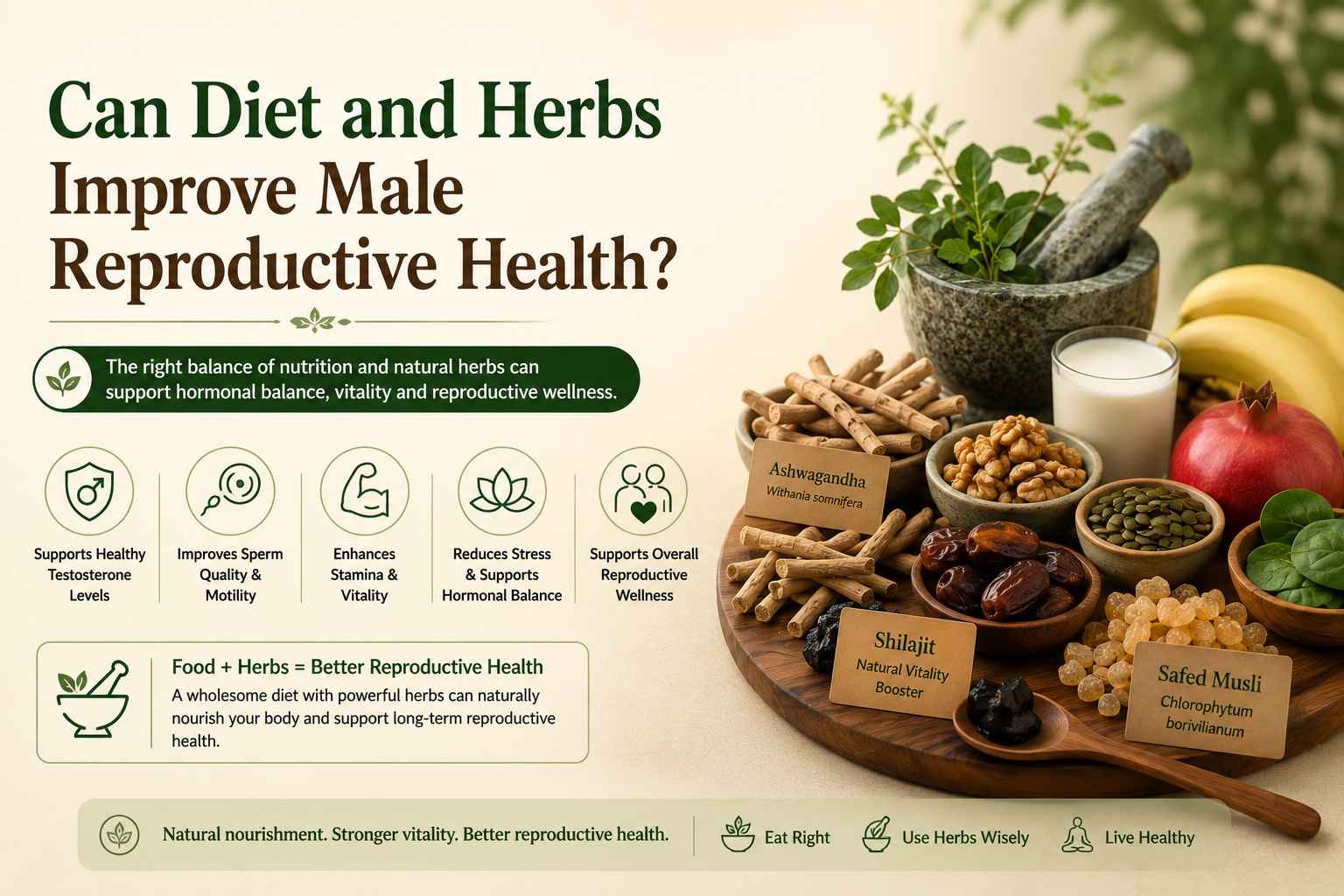
This is one reason researchers have become deeply interested in Ashwagandha. Not simply as a “traditional herb,” but as a measurable stress-regulating compound.
Ashwagandha: The Herb Modern Fertility Research Is Watching Closely
Ashwagandha has been used in Ayurveda for centuries as a rejuvenating adaptogen. But recent studies are now putting real numbers behind its reputation. In a 2025 double-blind placebo-controlled experiment, men using high-concentration Ashwagandha extract for 90 days had:
- 167% rise in sperm count,
- Semen volume increased by 53%,
- And a 57% increase in sperm motility.
Those are dramatic shifts.
Researchers believe one reason may be Ashwagandha’s ability to reduce oxidative stress and lower cortisol levels helping create a healthier hormonal environment for sperm production.
Because fertility isn’t only about “producing more.”
It’s about creating the right internal conditions for the body to function properly.
Shilajit: The Ancient Mineral Compound Linked to Testosterone Support
Few Ayurvedic substances are surrounded with as much curiosity as Shilajit. Traditionally known as a rejuvenator and vitality-support compound, purified Shilajit is now being studied for its effects on energy metabolism and hormone health. And the findings are interesting. In 2026, a study discovered that men who took purified Shilajit for 90 days, total testosterone rise 23.5% And a 19% increase in free testosterone. But what’s remarkable about Shilajit is the way it might work. Researchers think it helps boost mitochondrial function, basically helping cells create energy more efficiently. And sperm cells need enormous amounts of energy to function and move effectively. In simple words, healthy sperm are highly energy-dependent.
Which means fertility may have more to do with cellular energy than many people realize.
The “Dopamine Bean” and Male Fertility
Another herb attracting scientific attention is Mucuna Pruriens, traditionally called Kapikacchu in Ayurveda. Sometimes referred to as the “dopamine bean,” it naturally contains L-DOPA a precursor connected to dopamine production. But its fertility effects appear to go beyond mood and motivation. Studies in men with low sperm quality found improvements in:
- Sperm concentration,
- Hormone regulation,
- And reproductive signaling pathways.
Some findings observed sperm concentration improvements ranging between 30–40%. This is especially interesting because fertility isn’t controlled by one hormone alone. It involves a communication network between:
- The brain,
- Pituitary gland,
- Testes,
- Stress hormones,
- And metabolism.
Ayurveda recognized these mind-body connections long before modern endocrinology gave them scientific names.
Fertility Is Also Deeply Connected to Food
One of the biggest myths around male fertility is that supplements alone can “fix” everything. But modern research repeatedly points toward something simpler: The body builds sperm from the raw materials you feed it. Which means nutrition matters enormously.
Today, many fertility researchers point toward Mediterranean-style eating patterns combined with antioxidant-rich foods as one of the strongest nutritional approaches for male reproductive health.
Zinc: The Mineral Testosterone Depends On
Zinc plays a major role in:
- Testosterone production,
- Sperm formation,
- And reproductive signaling.
In fact, zinc deficiency has been associated with dramatic reductions in testosterone levels. Foods rich in zinc include:
- Pumpkin seeds,
- Oysters,
- Legumes,
- And nuts.
Sometimes the body isn’t “broken. Sometimes it’s simply undernourished.
Lycopene and the Surprising Power of Tomatoes
Cooked tomatoes contain lycopene a powerful antioxidant now being studied for sperm health. A 2025 meta-analysis found lycopene supplementation may improve sperm morphology (shape and structure) significantly. And shape matters more than most people realize.
Because healthy sperm need both movement and structure to function effectively.
Omega-3s Help Sperm Move Better
Sperm membranes rely heavily on healthy fats. Omega-3 fatty acids help improve membrane flexibility and fluidity, making sperm more capable of movement and egg penetration. This is one reason diets rich in:
- Fatty fish,
- Walnuts,
- Flaxseeds,
- And healthy fats
continue to appear in fertility-support research.
The Modern Habits Quietly Hurting Male Fertility
Sometimes fertility challenges aren’t only caused by what’s missing. Sometimes they’re caused by constant exposure to things the body struggles to handle. Modern research increasingly points toward:
- Endocrine-disrupting chemicals,
- Poor sleep,
- Dhronic stress,
- Excessive alcohol,
- Smoking,
- Sedentary living,
- And overheating
As major contributors to declining sperm quality. Even scrotal temperature matters more than people think. Research suggests that just a 1°C increase above baseline temperature may reduce sperm production significantly. Which suddenly makes years of laptop-on-the-lap habits and overheating lifestyles feel more relevant.
Male Fertility Is Becoming a Lifestyle Conversation
Perhaps the biggest shift happening right now is this: Male reproductive health is no longer being viewed as purely genetic. It’s increasingly being viewed as responsive biology.
Which means:
- Stress management matters,
- Sleep matters,
- Movement matters,
- Nutrition matters,
- And long-term lifestyle patterns matter.
This doesn’t mean every fertility challenge can be solved naturally. But it does mean the male body may be far more adaptable than people once believed.
Final Thoughts
For years, fertility conversations focused almost entirely on women. But modern science is making something clear: Male reproductive health is deeply connected to overall health.
The body responds to:
- Stress,
- Recovery,
- Nutrition,
- Inflammation,
- Hormones,
- And lifestyle choices every single day.
And perhaps that’s why Ayurveda still feels surprisingly relevant in modern fertility conversations. Because long before laboratories and hormone panels existed, it understood something simple, the body functions best when it is nourished, rested, balanced, and supported consistently.