Every few months, the internet discovers a new “skin detox.”
A charcoal mask.
A green juice cleanse.
A 3-day skincare reset.
A viral routine promising to “pull toxins out of your skin.”
And honestly?
Most people are exhausted trying to keep up.
Because despite the expensive serums, overnight masks, and complicated routines, the skin still feels:
- Irritated,
- Inflamed,
- Dull,
- Sensitive,
- Acne-prone,
- Or constantly “angry.”
Which leads to a bigger question: What if the problem isn’t only sitting on your skin?
What if your skin is reacting to something happening inside your body? This is where Ayurveda approaches skincare in a completely different way and surprisingly, modern science is beginning to pay attention.
Ayurveda Never Saw Skin as “Just Skin”
Long before modern dermatology started talking about the gut-skin axis and inflammation, Ayurveda believed something fascinating: Your skin is a reflection of your internal balance.
In Ayurvedic science, the skin is deeply connected to:
- Digestion,
- Liver function,
- Blood quality,
- Inflammation,
- Stress,
- Sleep,
- And even emotional health.
This process is traditionally known as Rakta Shodhana often translated as “blood purification.” Now, before you imagine mystical detoxes or toxins magically sweating out of pores, let’s clear something up: Ayurveda’s idea of detox is far more intelligent than internet detox culture.
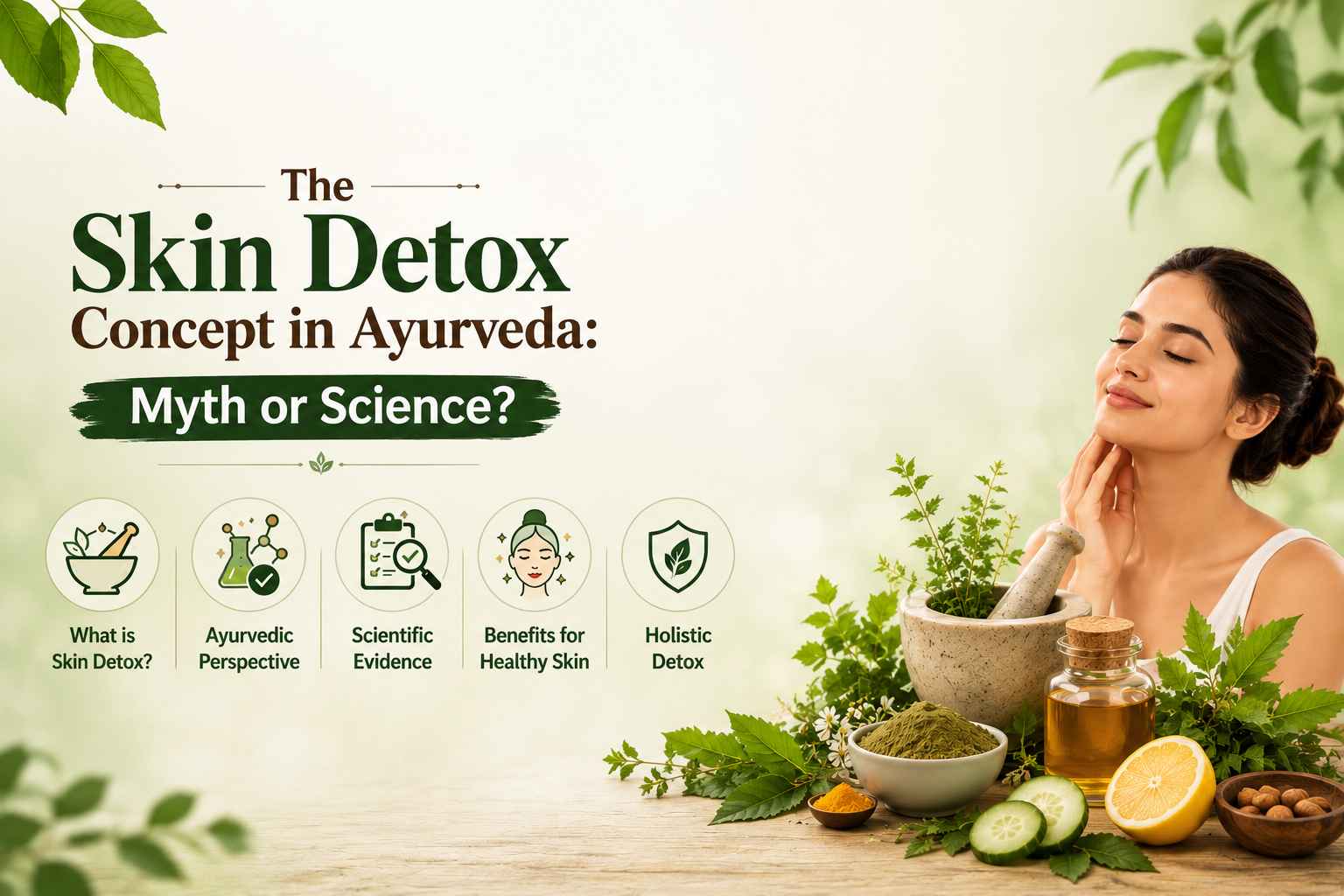
So Is “Skin Detox” Real or Just a Marketing Myth?
The answer is: The buzzword is oversimplified. The biological process behind it is very real. Your skin doesn’t literally “push out toxins” the way social media often claims. But your body does have interconnected detoxification systems:
- The liver,
- The gut,
- The kidneys,
- The lymphatic system,
- And the skin itself.
When those systems become overloaded, because of poor diet, stress, inflammation, pollution, poor sleep, or digestive imbalance, the body often shows signs externally.
And the skin becomes the messenger. Sometimes that message looks like:
- Acne,
- Eczema,
- Redness,
- Sensitivity,
- Dullness,
- Inflammation,
- Or stubborn breakouts that no skincare product seems to fix.
Ayurveda recognized this connection centuries ago. Modern science is only now beginning to validate it.
Your Skin May Be Reflecting Your Liver More Than Your Moisturizer
One of the most fascinating concepts in Ayurveda is the liver-skin connection. In Ayurvedic understanding, the liver is closely tied to Ranjaka Pitta, a metabolic force associated with blood quality, heat, and inflammation.
When the liver becomes sluggish or overloaded, inflammatory compounds may begin affecting the skin. And modern research is beginning to explore exactly this relationship. A 2025 study on Manjistha, one of Ayurveda’s most respected “blood-purifying” herbs, found a significant reduction in inflammatory markers like CRP in people with chronic acne.
That’s important. Because it suggests Ayurvedic herbs may not simply “clean the skin” they may help reduce the internal inflammation driving the skin issue in the first place.
That changes the entire conversation around skincare.
Your Gut and Your Skin Are Constantly Talking to Each Other
Have you ever noticed how stress, bloating, processed food, or poor digestion often show up on your face days later? That’s not coincidence. Modern science now refers to this as the Gut-Skin Axis a direct communication pathway between digestive health and skin inflammation. Ayurveda has emphasized digestive health for thousands of years. Not because digestion only affects the stomach but because digestion affects everything.
Recent studies on Triphala, a classical Ayurvedic formulation, showed improvements in gut microbial diversity within just a few weeks. Why does that matter? Because a healthier microbiome may help:
- Reduce systemic inflammation,
- Calm skin sensitivity,
- Improve barrier function,
- And lower redness and irritation.
Sometimes the glow people are chasing isn’t hiding in a serum. Sometimes it begins in the gut.
Ayurveda Doesn’t Believe in Aggressively “Stripping” the Skin
Modern skincare often treats the skin like a battlefield.
Dry it out.
Exfoliate harder.
Use stronger acids.
Kill more bacteria.
But Ayurveda takes a surprisingly gentle approach. Instead of attacking the skin, Ayurveda focuses on strengthening it. This is where practices like Snehana (oleation) become important. Yes, Ayurveda uses oils intentionally. And science is beginning to understand why.
Why Ancient Ayurvedic Oils Are Making a Comeback
For years, people believed oily skin needed harsher products and less oil. But the skin barrier tells a different story. Your skin naturally depends on lipids and essential fatty acids to stay:
- Resilient,
- Hydrated,
- Protected,
- And calm.
Ayurvedic oils such as:
Neem oil, Black cumin seed oil, Sesame oil and herbal infusions include chemicals that can assist to organically heal and improve the skin barrier. A 2026 study on traditional Ayurvedic oleation therapies discovered that these therapies reduce lipid peroxidation which helps the skin protect itself against pollution and oxidative stress.
In simpler words? These rituals may help the skin become less reactive to the modern environment. And in today’s polluted, overstimulated world, that matters more than ever.
Neem: Ayurveda’s Ancient “Skin Guardian”
Few herbs are as iconic in Ayurvedic skincare as Neem. And for good reason. Neem contains powerful bioactive compounds like nimbin, which researchers have studied for their antibacterial and anti-inflammatory effects.
Some 2024 findings even suggested Neem performed comparably to benzoyl peroxide against acne-causing bacteria but with significantly less dryness and irritation. That’s a huge difference. Because many people today are trapped in cycles of:
- Over-cleansing,
- Over-exfoliating,
- And damaging their skin barrier while trying to “fix” acne.
Ayurveda instead asks: What if calmer skin heals better?
Manjistha: The Herb Ayurveda Calls a Blood Cleanser
If Neem protects the skin externally, Manjistha works internally. Traditionally used for Rakta Shodhana (blood purification), Manjistha is now gaining attention for its role in inflammation regulation. Research suggests it may help modulate cytokines the inflammatory messengers associated with redness, swelling, and cystic acne. Which means Ayurveda wasn’t just talking poetically about “purifying blood.”
It may have been describing systemic inflammation long before modern terminology existed.
True Skin Detox Is Slow, Not Viral
This is important. Ayurveda never promised overnight skin transformation. Because biologically, real skin healing takes time. Skin cells naturally renew over approximately 28–40 days. Which means:
- No mask can “detox” your face in 20 minutes,
- No overnight trend can rebuild a damaged skin barrier,
- And no harsh purging should be normalized endlessly.
In fact, Ayurveda prioritises gradual balance over dramatic reactions.
Real healing often looks quieter:
- Less inflammation,
- Calmer breakouts,
- Stronger skin,
- Improved digestion,
- Better sleep,
- And steadier energy.
Not viral before-and-after photos.
Maybe Your Skin Isn’t the Problem
Maybe it’s the messenger. Maybe the acne, dullness, sensitivity, or inflammation is the body asking for:
- Better digestion,
- Less stress,
- Deeper sleep,
- Anti-inflammatory nourishment,
- Hormonal balance,
- Or nervous system recovery.
This is the core philosophy behind Ayurvedic skin wellness.
Not “perfect skin.”
Not filtering reality.
Not chasing glass skin trends.
But creating internal balance so the skin can function the way it was designed to.
Final Thoughts
The modern world often treats skincare like surface maintenance. Ayurveda treats it like a reflection of internal harmony. And perhaps that’s why Ayurvedic skincare continues to feel timeless. Because it reminds us of something simple, but powerful: Healthy skin is not only created by what you apply. It is deeply influenced by how you live, eat, sleep, digest, and heal. Maybe true skin detox was never about removing toxins from the face.
Maybe it was always about reducing the burden on the body so the skin no longer had to speak so loudly.